
Stainless steel 304 vs 316: which choice for your liquid process?
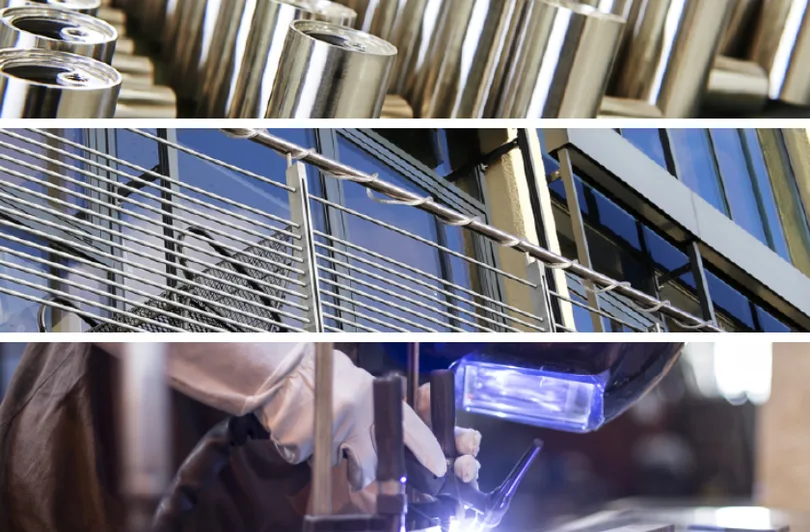
When designing a tank, piping or liquid process system made of stainless steel, one question quickly arises: should we choose 304 or 316 stainless steel?
Both are widely used in industrial and sanitary environments. They offer good resistance to corrosion, are suitable for the fabrication of welded equipment, and can be suitable for many applications in the food industry, brewing, cosmetics, pharmaceuticals, and the chemical industry. However, they are not interchangeable.
316 offers superior resistance in several corrosive environments, especially in the presence of chlorides. However, this additional performance comes at a cost. Choosing 316 systematically can therefore unnecessarily increase the project budget. Conversely, choosing 304 solely to reduce the initial investment can become costly if the actual conditions of the process cause premature corrosion.
The good question is therefore not: which steel is the best? It is rather: Which steel is really suitable for the conditions of your process?
What is the difference between stainless steel 304 and 316?
Both 304 and 316 belong to the family of austenitic stainless steels. Their corrosion resistance is based, among other things, on chromium, which allows a thin protective layer to form naturally on the surface of the metal.
The main difference that interests us here lies in the composition of 316: it contains molybdenum, unlike 304. 316 generally contains around 2 % % molybdenum, which improves its corrosion resistance, especially in certain environments containing chlorides.
In simple terms:
Stainless steel 304 | Stainless steel 316 |
|---|---|
Very widespread in the industry | Used when the environment is more corrosive |
Good resistance to general corrosion | Increased resistance to localized corrosion |
Suitable for many food and beverage applications | More suitable for chlorides and certain chemical environments |
Generally more economical | Generally more expensive |
However, this does not mean that all food installations should be made of 304 stainless steel and all pharmaceutical installations should be made of 316 stainless steel. The product transported is only part of the equation.
When is 304 enough?
In many liquid processes, 304 is perfectly suitable. It is also widely used for tanks, piping and various components of food processing equipment. 316 is sometimes presented as the food grade, but this designation can be misleading: there is no general rule that equipment in contact with food must necessarily be made of 316. 304 is also suitable for many food applications.
For a relatively non-corrosive process, with controlled temperatures and low exposure to chlorides or aggressive chemicals, investing in 316 does not necessarily provide sufficient benefits to justify the additional cost.
This is particularly relevant when a project involves a lot of stainless steel. On a tank, a piping network or a complete skid, the difference in material can have a real effect on the overall cost. Paying more is only relevant if the terms of use justify this additional protection.
When does the 316 become interesting?
The 316 takes advantage when the environment becomes more aggressive. Thanks to the molybdenum present in its composition, it resists better than the 304 to several forms of localized corrosion. This difference becomes particularly important in the presence of chlorides, which can favor puncture corrosion and corrosion in confined areas.
Therefore, the 316 will be considered more seriously when the process involves, for example:
- a greater exposure to chlorides or salt;
- certain chemical products or acidic solutions;
- particularly aggressive cleaning conditions;
- high temperatures combined with a corrosive environment;
- high life expectancy requirements in a harsh environment.
In the chemical and pharmaceutical industries, 316 or 316L is very common. But again, 316 does not mean indestructible.
Attention: 316 is not an insurance against all corrosion
This is probably one of the most important points to remember. Switching from 304 to 316 increases resistance to certain corrosive conditions, but this does not guarantee that equipment will withstand any chemical product or any concentration.
Let’s take an extreme case: hydrochloric acid. The common stainless steels 304 and 316 may both be inadequate for this type of environment. In some particularly aggressive applications, the right decision is therefore not to switch from 304 to 316, but to evaluate another nuance or another material.
Temperature also matters. An acceptable chloride concentration under certain conditions can become much more problematic as the temperature increases. Warm, chloride-rich environments can, in particular, increase the risk of stress corrosion cracking for common austenitic steels. That is why choosing only based on the product name of the transported product is rarely sufficient.
Agribusiness and brewing: the 316 is not always necessary
In the food processing industry, bakery products, dairy products or beverages, 304 often represents an excellent starting point. It is commonly used for tanks, vessels, equipment and piping systems when the process conditions are not particularly corrosive. For more corrosive foods or beverages, especially when they contain more salt, 316 may be preferable.
It is also necessary to consider what happens between two productions. A relatively mild product for steel can be followed by a much more aggressive cleaning cycle. The chemistry of the cleaning agent, its concentration, temperature, contact time, and the quality of rinsing are therefore integral parts of the material selection. In other words, the material must be chosen for the entire cycle of use, and not just for the liquid sold to the end customer.
Chemical, pharmaceutical and cosmetic industries: looking beyond the product
In chemical, pharmaceutical and cosmetic processes, 316L is frequently preferred when conditions require increased resistance to corrosion. But even in these sectors, shortcuts must be avoided.
A pharmaceutical process does not automatically require 316 simply because it is pharmaceutical. Conversely, a food facility may very well require 316 if it is exposed to salty products, aggressive cleaning agents, or other corrosive conditions. The industry therefore provides a preliminary indication, but it is the actual conditions of use that provide the answer.
The 5 questions to ask before choosing
Before determining the stainless steel grade of a liquid process system, five pieces of information are particularly useful:
- What liquid will come into contact with the equipment? Its chemical composition is the first element to be known.
- Does it contain chlorides, salt or particularly corrosive substances?
- At what temperature does the process work? Temperature can significantly alter the behavior of a material.
- How will the equipment be cleaned? A CIP system and its chemical products must be considered on the same level as the manufactured product.
- What are the operating conditions? Contact time, concentrations, potential stagnation and the frequency of cycles can all influence the risk of corrosion.
These questions allow us to break free from the «304 or 316?» reflex and make a real engineering choice.
The initial cost is only part of the calculation
304 is generally less expensive than 316. Therefore, it can represent a significant saving when it truly meets the needs of the process. But the opposite is also true.
Saving on the initial material to have to repair a piping system, replace a tank, or interrupt production prematurely is not an economic decision. In this case, the additional cost of 316 can become a way to protect the lifespan of the installation and reduce operational risk. The right choice is therefore the one that balances initial cost, process conditions, maintenance, corrosion risk, and expected lifespan.
So, 304 or 316?
There is no universal answer. For many food and beverage applications that are relatively non-corrosive, 304 can perfectly suffice. When chlorides, certain chemicals, or more aggressive conditions come into play, 316 or 316L often becomes more relevant. In particularly harsh environments, it may even be necessary to go beyond these two nuances.
Aran designs and manufactures precisely tanks, skids and piping systems adapted to the specific needs of each installation. From design to installation on site, the Aran team manufactures each equipment custom-made, according to the real conditions of your process.
The goal is therefore not to automatically choose the most expensive material. The goal is to understand what will actually flow through your system, under what conditions and for how long, and then choose the steel capable of doing the job without unnecessarily overdimensioning the project. It is this analysis that allows us to correctly answer the question: do I really need 316, or is 304 enough?
Discover more articles
Modular skid or custom installation? Timelines, downtime costs, access and space: questions to ask to speed up your…
Corrosion, cracks, repeated repairs: discover 5 signs that an stainless steel tank needs to be repaired or replaced.
Standard equipment or custom-made fabrication? Discover when custom-made becomes relevant for an industrial liquid process system.
One Response